Sunday, September 13, 2015

Back to School


It has been a wonderful return to school this year!  My sweet scholars and I have been having a blast getting to know each other.

Our school hosts a Meet the Teacher night the Thursday before school begins, which is a fun way to meet the children and families before the first day of school.  I had the desks set up with notes from former students and a note from me.  (Click here if you want the editable version.)


I also used these adorable labels on bubbles from the dollar store.  I'm not sure who to credit, because all I can find is the Google Drive file.  However, they are a hit every time!  I'm sorry I keep forgetting to take a picture!

Finally, I gave bookmarks to each family to help them remember that parents are key to our success, especially when it comes to building a love of reading.

I hope you're enjoying a wonderful start to the school year!

Tuesday, April 21, 2015

Morning Meeting Greetings


As you know, we have a morning meeting (or afternoon meeting, depending on our schedule) each day in my classroom.  We love saying hello in many different ways!  Here are a few ways we've been greeting each other lately.  If you want to use them in your classroom, just click on the image for a freebie.

Dice Roll

Roll the dice and  find the sum (or difference, depending on the skill you're practicing).  
Count that many people around the circle.
Shake hands with the person you end on.

I use giant dice for this.  I got these as a gift from an AMAZING PE teacher who used them in his class:


And I bought these at Mardel for when we are just starting out.  They also work well in the lower grades.  You can also use them to build number sense.  So, instead of finding the sum, you could roll 1 die and count that many people to greet.


 Giant Soft Cubes with Numbers


Who Rocks the House?

Say this chant, with each child taking a turn dancing in the center of the circle.
Who rocks the house?
(Child's name) rocks the house!
And when (child's name) rocks the house,
She rocks it
all the way down!

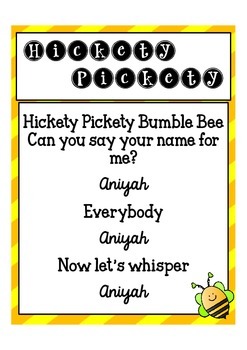
 Hickety Pickety Bumble Bee

Hickety Pickety

Hello in Many Languages

Choose a language.  Choose a person to start.
The person who is starting turns to the person next to him/her and says, "Hello (child's name)" in the selected language.
The greeting is then passed around the circle.
A few ways to say hello: jambo, hola, bonjour, hodi, kon'nichiwa

Multidigit Addition Match Up

Each person takes 1 card and solves the addition problem on it.
Students sit in a circle and take turns greeting the person with the matching sum.
Note: Some of the cards intentional have similar sums to help scholars work on accuracy.  We do this as a whole group the first few times, so we can double check our work.  After that, we might solve and find the person matching sum without sitting in a circle.

Multi-digit Addition Match Up

Saturday, April 11, 2015

Easy Classroom DIY - Guided Reading Phones


Confessions: I love DIY, and I am a Pinterest junkie.  Evidence: My husband and I made this out of our broken fence, and we had a BLAST!  (Details to come, in case you want to try something similar in your classroom.)


My first classroom DIY project was to create guided reading phones when I started teaching ages ago.  They are insanely easy and very inexpensive.  More importantly, they have been incredibly helpful for my young scholars.  The tutorial is below, but first, here's how they help: 

Fluency: Students can hear themselves read, so they are more inclined to notice when they are "Robot Reading".  (Audacity is another great tool to help with this.  They can record themselves, listen to their finished work, and evaluate it with a rubric.)

Self Monitoring: In the younger grades, the children often do not listen to what they're saying as they read.  The Guided Reading Phone is a great reminder to pay attention to what you're saying and make corrections when it doesn't make sense.

Focus and Independent Work: It can be difficult for young scholars to focus on their own thinking when people around them are reading out loud.  If they are reading the same book, children may find themselves reading chorally with the person who is the best at decoding, rather than doing the work of decoding on their own.  The phones are a great way to help children focus on what they are doing and prevent distraction.

Fun! Above all, reading should be fun!  My biggest goal is to inspire students to catch the love of reading.  I do everything I can to help them experience the pure joy of reading a good book.  If a Guided Reading Phone makes them willing to try it, I'm all in!

The phones are totally worth it and have been really helpful for my little ones.  You can buy them for about $5.00 each at almost any education store.  You can also make them with a couple items from the hardware store.  I've included pictures of the packaging at Home Depot (where I got my supplies), so you could see the skew number.  They were much harder to find when I made a few new ones last week, so I thought more details might be helpful for you!

Here's what you need:


All you do is fit them together in the shape of a phone.  Couldn't be simpler!  I usually wipe them off with an antibacterial cloth after making them, just to be safe.


Happy Reading!


Wednesday, April 8, 2015

Earthdance, Roller Coaster and a Writing Lesson


I just adore books that teach a million things at once and leave you with that satisfied, peaceful feeling when you close them.  Earthdance is one of those books.  It is one big celebration of Earth and all those who dwell here.

Displaying IMG_1903.JPG

 The book is fantastic as a read aloud, just for pure enjoyment.  It's also a great addition to an Earth Day celebration.  You could use it at the beginning of the school year to remember that we are part of something bigger and everyone around us is valuable.  I love to celebrate diversity at the beginning of school; it sets the tone for the whole year.

Another great way to use Earthdance is as a mentor text for writing.  The illustrations perfectly capture the structure of a story and lend themselves well to teaching a story map.  It would be great to pair it with Roller Coaster, which I use as a mentor text when I'm teaching small moment stories.  

Image result for roller coaster book

I've often used it to remind students that our stories really work like a roller coaster.  Earthdance is another great mentor text for the same topic.  This year, I was inspired by Cole Elementary to use this anchor chart, instead of the simpler version I usually create.  (Click on the image to check out their blog.  There are some other great anchor chart ideas there.)

http://thecoletrain5060.blogspot.com/2011/10/hooked-on-anchor-charts.html

 This really helped my young writers remember the structure of the story.  I especially loved the idea of using the sticky notes to plan and evaluate our stories.  We used them to check a draft I had written and discovered that my story needed some revision - it was missing the action!

The students created roller coasters in their notebooks and used sticky notes to plan and evaluate their own stories.  It was so sweet to see them using their hands to create the roller coaster as they re-told their stories.

I wish I thought to take pictures of their work, but I was way to involved and excited by conferencing with them to think about that!

Anyway, Earthdance is a fantastic follow up lesson, because it shows that the action and excitement of a story can go beyond just the problem and solution.  A book can have a fabulous purpose and carry great meaning by making a simple variation to the story structure.

I can't wait to try it out!

Monday, April 6, 2015

Peek at My Week - Field Trip


It is a field trip week for us!  My young scholars and I are SO excited to visit the aquarium!

Here's a quick peek at everything else we're up to this week:


We have lots of fun planned for our aquarium trip, too.  First, we will do some research on different types of animals and their habitats as part of our digital learning classroom challenges.  (Our ITS is seriously a genius.)  Check out everything we're doing on Twitter.  You can follow me (mrszenyuch) or just check out #bigDEALjmt

  Anyway... we'll use our research to write predictions about which animals we'll see at the aquarium.  We'll write them on these colored bands (conveniently also the colors of our groups) and wear them as bracelets.  They'll become a scavenger hunt as we travel through the aquarium.  We'll earn bonus bucks for every animal we find.


They are very simple, but they are our field trip version of the HOWL bracelets we've been using at school.  Our PBIS team came up with these awesome bracelets, and the kids are LOVING earning them.  Anytime an adult sees them doing something correctly in a common area of the school, we get to celebrate their success with a bracelet.  We can't give them to our own students, so it's been equally exciting to cheer for my students when they earn them! 


While we're at the aquarium, we will also work on discovering how animals interact with their environments using this interactive notebook page. We'll glue it into our notebooks before we leave for the trip, and work on it while we're there.  When we get back, each child will create an animal that would fit into the environment he/she picked.


Finally, anyone who wants to earn Bonus Bucks can work on one of our #bigDEALjmt classroom challenges.  I selected the ones that would be most successful during the trip, and we'll take the iPads with us (Yup!  I am just that lucky!), so the kids can use technology to show what they know.


I hope you have an awesome week!


As always I'm linking up with the wonderful Mrs. Wills.  Click on her button to find out out what everyone else is up to this week.


Friday, April 3, 2015

A Lenten Fasting Experience for Children


Lent can be a tricky time for adult leaders.  We want our children to grasp the full power of God's love for them.  We want them to know that He gave His Son so that we might be forgiven.  It's a powerful idea with some fairly graphic and not so child-friendly images.  At the same time, there is such power in understanding this incredible sacrifice, and many of us want our kids to be drawn closer to Him by developing a deeper understanding of this incredible, awe-inspiring love.

The beauty of childhood is that many children already have a bigger understanding of God's love than we realize, because they do not live with the knowledge of limitations that many adults carry with them.  For children, God's love being all around them can be a very real thing.

In my return to the classroom this year, I realized that a lot of learning takes place when the teacher sets up the environment and steps out of the way.  With that in mind, I've created this Lenten lesson plan for elementary children.  It is designed to be started on Ash Wednesday, if you are in a school setting, or on the first Sunday of Lent, if you are in a church.

Introduction:
Leader:  Lent is a time when we remember that Jesus made a huge sacrifice, so we could be forgiven.  One of the ways we can draw closer to God during this Lenten season is to fast from something.  Some people choose to fast from a particular food or food group.  Others fast from video games, TV, or something else they do or use daily.  Today, we are going to consider the idea of fasting.  If you were going to choose to fast, what might you fast from?

Work together with the children to create a chart of things you could fast from.

Activity:
Leader: These are some great ideas of things we could fast from.  Now, I want you to think about how you would like to draw closer to God during the next few weeks of Lent.  I'm going to turn on some music as we think about which of these choices might be a good fit for us or if there is something else we'd like to do.

As always, we begin with prayer.  If we are hoping to spend a few weeks drawing closer to God, we definitely want to begin with a conversation with Him!

When you know how you'd like to focus the next few weeks, pick up an egg & choose a piece of paper and a marker.  On the paper, write or draw your choice, then put it in your egg.  You can write your name on the outside of the egg, then spend some time in silence.  You can pray, think, or meditate.

At the end of the song, we'll bring our eggs together for a group prayer.

Turn on the music and allow the children to complete the activity.  Be sure to do the same.  A few music options are: Draw Me Close to You by Hillsong, How He Loves by David Crowder Band, and What Wondrous Love is This? by Chelsea Moon.  All are available through YouTube.

Closing:
Collect the eggs in a basket and form a circle with the basket in the center.  Hold hands and pray.  Here is a prayer idea, if you need one:
Father, we thank you for your unfailing love and presence in our lives.  We are so grateful for Jesus incredible sacrifice for us and the forgiveness of our sins.  We hope to spend this Lenten season drawing closer and closer to you.  Please help us to come to you in prayer each time we would have used whatever it was we are fasting from.  Help us to learn from you and know you more and more each day.  We love you, and we praise you.  Amen.

Easter Celebration:
When Easter arrives, distribute the eggs and reflect on how the fasting experience helped you draw closer to Christ.  You might consider spending some time drawing or writing about the experience.  In a school setting, this would be a great journal or free writing piece.

Here are a few reflection questions you could use in small or large group:
- Were you able to fast the whole time?
- What did you do when you REALLY wanted the thing you were fasting from?
- How did this help you grow closer to Christ?
- In what ways does this compare to Christ's sacrifice for us?

Alternate:
Of course, this idea came to me on Good Friday, so if you don't want to wait a whole year to try it, you might consider doing something big (no TV, no technology etc) just for the weekend.  Of course, it becomes important in this case to remind children not to fast from food, water, or any other basic needs for the whole weekend.  This would also be a great option for something to do as a whole family!

Tuesday, March 31, 2015

Morning Meeting


I have hosted a daily class meeting nearly every day since I started teaching.  This year, I moved to a new district, received some seriously awesome PD, and began questioning whether I was wasting time with my daily meetings.  I wondered if I would have more time for content if I removed the meeting.  After all, a quality meeting takes about 15-20 minutes, and my instruction during that time isn't necessarily standards-based.  

I experimented with having meetings only twice a week and using share time to cover specific content.  After about a month, I realized that my students weren't as focused on their work, and I wasn't as focused on teaching.  Sadly, we were focused on resolving conflicts, setting goals about using physical violence to solve problems at school, and handling social concerns.  Temper tantrums in my classroom were at an all-time high.

Enter the return of Morning Meeting!  I know this sounds crazy, but I definitely noticed a difference on the days we had our class meetings... So I brought them back.  I modified the content to better fit the meeting structure and returned to running the meeting the way Responsive Classroom suggests, with a few additions from Open Circle

My classroom is back to running smoothly, and I am no longer spending every waking moment trying to figure out how to solve behavior problems that I haven't ever experienced before.  It turns out, I was having a tricky year, because I removed some of the structures that helped the students learn social skills they were applying throughout the day.  Never again!

There's SO MUCH that I could say about Morning Meeting, why it's awesome, and how to run it.  Here are a few basics to get you started if you've never done it before.  Stay tuned for more specific details and ways I've started embedding content into our meeting in a way that is a little more authentic and effective for both the social skills and the content.

If you've never tried it before, please let me know how it goes!  I'm rooting for you! 
Here's the template I created to plan my meetings. Click HERE for the freebie.


Typically, I plan the meetings at the beginning of the year.  Once students get used to the structure and know a bunch of greetings and activities, I step out of it and allow them to choose what they'd like to do.  This is a gradual process, of course, and it allows them to take on leadership and ownership of some of our activities.

I also run the meeting at the beginning of the year.  This year, I led the meeting for the first month of school.  In fourth and fifth grade, I only run it for a week.  In Kindergarten, I ran it for the first half of the year.  Once we have our first class election, I invite the president to take over the meeting.  Other teachers I know have had the student of the week run the meeting.

Once the president takes over, I really only lead the message portion of the meeting.  Each day, my students enter the classroom and read the morning message, which is a letter I've written to them. 

At the beginning of this in kindergarten, the message looked like this:


Here's a letter I recently used in second grade.  We were working on stamina and reading the WHOLE way through something to glean all the information, so it's much longer than a usual letter.


As I said, I love Morning Meeting and teaching social skills, and I'd love to hear how it's working in your classroom!  Please share your wisdom (or questions) in the comments or shoot me an email and let me know what's working (or not) for you.